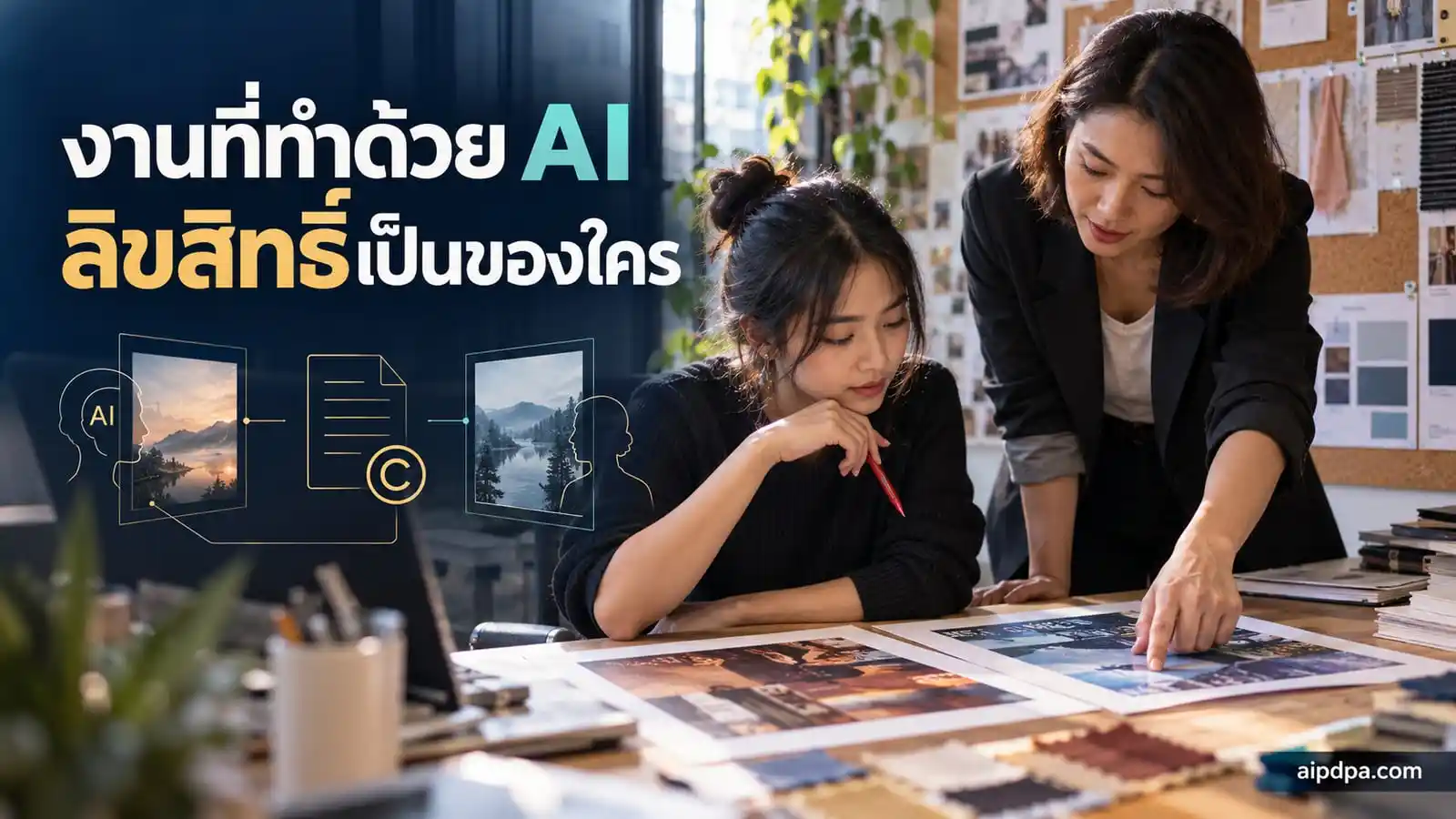
Ownership of work made with AI under Thai copyright law is a question the Copyright Act B.E. 2537 does not answer directly, since Section 4 defines the author as the person who makes or creates the work. Parts that people write, edit and select fit that definition more clearly. This is for companies using AI, who get the rules for employee work (section 9), commissioned work (section 10) and infringement risk (section 27).
- The Copyright Act B.E. 2537 never mentions artificial intelligence, and our corpus holds no Thai court ruling on AI-made work.
- Section 4 defines the author as the person who makes or creates the work, so human-made parts are clearer than pure AI output.
- Copyright in employee work stays with the employee under section 9 unless otherwise agreed in writing.
- Copyright in work by an agency or freelancer vests in the commissioning party under section 10 unless agreed otherwise.
- The ETDA guideline says to check outputs before publishing and read the AI provider's terms, but it is guidance, not law.
Picture this: a company's marketing team has AI generate a campaign image. Someone types a few lines of prompt, picks the image they like, tweaks the colours and puts it on a billboard. Three months later a competitor runs something very similar, and the first thing management asks is: "Can we sue?"
The honest answer is: not clear. Thai copyright law was written before generative AI and says nothing about it. This article works through what the statute does settle, where the gaps are, and how a marketing team should work while there is no answer.
Does Thai copyright law say anything about AI?
Nothing at all. The Copyright Act B.E. 2537, as consolidated up to Amendment No. 5 of B.E. 2565, does not use the term artificial intelligence anywhere. Ownership therefore comes back to the basic definition in section 4. The English below is the Department of Intellectual Property's translation; for legal use the Thai text is the reference.
“author” means a person who makes or creates any work, which is a copyright work by virtue of this Act;
The Thai wording is "the one who makes or causes to come into being" a creative work. It does not say the author must be human, nor does it forbid tools. Two open questions follow. First, is an image generated from a short prompt a "creative work" in the legal sense? Second, if it is, does the person typing the prompt count as the one who brought it into being?
The statute answers neither, and our legal corpus contains no Thai court ruling or Department of Intellectual Property guidance on the point. Anyone telling you Thai law has "settled" this, either way, should be asked for the source.
Is a prompt protected?
Section 6 paragraph two excludes ideas from protection from the outset. The idea of "a cat in Thai costume in front of a temple" belongs to no one; anyone may have it. A long, carefully composed prompt might be a literary work in its own right like any other writing, but that protects the prompt text, not the image it produces.
Copyright protection shall not extend to any idea or procedure, process or system or method of use or operation or concept, principle, discovery or scientific or mathematical theory.
Who is likely to own what, depending on how AI is used?
Where the law gives no direct answer, the workable approach is to sort work by how much a person actually did. The table below is the AIPDPA team's reading of the statute, not a court or agency ruling. The last column says how confident you can be.
| How AI is used | Likely author | Section relied on | Clarity |
|---|---|---|---|
| Employee writes the article, uses AI to fix typos or suggest synonyms | The employee who wrote it | s.4 · s.9 | Clear |
| AI drafts, a person rewrites, adds and restructures most of it | The parts a person wrote and edited belong to that person | s.4 | Fairly clear for the human parts |
| A person selects and arranges several AI images into a set or layout | Selection and arrangement may be human work; each image remains unclear | s.4 · s.12 (needs interpretation) | Unclear |
| Short prompt, AI image used almost unchanged | The law does not say | — | No answer in Thai law |
| Someone else's work fed in and AI asked to adapt it or make "the same style" | The output may be an adaptation of the original owner's work | s.27 | Infringement risk |
The lesson from the table: the more a person does, the stronger the ownership case. In practice, keep evidence of what people did, such as each draft, edited files and the reason a version was chosen, not just the final file.
If an employee uses AI at work, does the company own the copyright?
Not automatically. Many companies assume that work done on company time always belongs to the company, but section 9 sets the opposite default: copyright stays with the employee who created the work unless otherwise agreed in writing. The employer only gets the right to communicate the work to the public for the purpose of the employment.
Copyright in the work created by the author in the course of employment vests in the author unless it has been otherwise agreed in writing, provided that the employer is entitled to communicate such work to the public in accordance with the purpose of the employment.
Apply that to AI and nothing changes. What the employee wrote or edited belongs to the employee absent a written agreement, while pure AI output may not be protected at all. The company's protection is the same as for any work: a written agreement in the employment contract or signed work rules. Details are in the employee copyright guide.
Hiring an agency or freelancer that uses AI
Commissioned work follows the opposite rule from employee work. Section 10 gives copyright to the party who commissioned it unless agreed otherwise, which sounds like good news for companies hiring agencies.
Copyright in the work created in the course of commission vests in the employer unless the author and the employer have agreed otherwise.
But section 10 vests copyright "in the work". If what the agency delivers is almost entirely AI-generated and was never protected in the first place, there is nothing for the client to receive, even after paying in full. That is the team's reading of the text, not yet confirmed by any court, but it is reason enough to write the contract carefully.
If the deal is that the agency keeps copyright and assigns it later, mind section 17 paragraph three. An assignment must be in writing and signed by both parties, and if no duration is stated the law deems it to last ten years.
The assignment of copyright by other means, except by inheritance, must be made in writing with signatures of the assignor and the assignee. If the duration is not specified in the assignment contract, the assignment shall be deemed to last for ten years.
- Require the agency to state in writing which deliverables used AI, and which tools
- Require a warranty that no third-party work was fed into AI to copy or adapt it
- Ask for working files, not just finals, as evidence of the human contribution
- State who is responsible if someone claims a deliverable infringes their copyright
- If copyright is assigned, do it in writing, signed by both sides, with a clear duration
Can using AI make us infringe someone else's copyright?
Yes, and this risk is clearer than the ownership question. Section 27 treats unauthorised reproduction, adaptation or communication to the public of a copyright work as infringement. It makes no distinction between doing it by hand and doing it with AI.
Any of the following acts against a copyright work by virtue of this Act without authorization in accordance with section 15 (5) shall be deemed an infringement of copyright: (1) reproduction or adaptation; (2) communication to the public.
The riskiest habit in marketing is feeding in someone else's ad, photo or article and asking the AI to "make something similar". An output that copies the significant part of the original may count as an adaptation under the section 4 definition. The other risk is an AI producing something that happens to resemble an existing work without the user noticing.
How far does the section 32 exception help?
Section 32 paragraph one is the general test: an act does not infringe if it does not conflict with the owner's normal exploitation of the work and does not unreasonably prejudice the owner's legitimate rights. Paragraph two lists specific cases, such as non-profit research or study, and criticism or news reporting with acknowledgement of the owner.
An act against a copyright work by virtue of this Act of another person which does not conflict with a normal exploitation of the copyright work by the owner of copyright and does not unreasonably prejudice the legitimate right of the owner of copyright shall not be deemed an infringement of copyright.
Advertising is plainly commercial, so the paragraph two list, much of it tied to non-profit use, is hard to lean on. As for the big question of whether training an AI model on other people's work falls within the exception, section 32 does not say, and Thai law has no exception aimed specifically at it.
The AIPDPA team's note on the direction of Thai AI law records that the draft principles of an AI law include a copyright exception for text and data mining (TDM) with an opt-out for rights holders, and that it drew the lowest support of the main principles in the public consultation. As of that note, no Thai AI Act had been published in the Royal Gazette, so this is not law.
What does the ETDA guideline say about intellectual property?
The Generative AI Governance Guideline for Organizations, from the AIGC under ETDA, uses an example that fits exactly: a bank's marketing team using AI to produce credit card ads, with intellectual property flagged as a risk. Its suggested control has two layers, check copyright law and check the AI provider's terms.
the organization should regularly review requirements, including laws related to copyright and other relevant laws, since Generative AI may use images or media on the internet that are copyrighted, and should also review the policies and terms of the Generative AI service provider as to whether it complies with relevant laws or requirements.
The guideline's annex, a sample use policy, puts the duty on users directly: take care not to infringe copyright or trademarks. That matters for advertising, because AI readily produces logos or product looks resembling another brand's.
2) Careless application of Generative AI may cause the Office to commit an infringement of intellectual property rights. Therefore, users of Generative AI must exercise care to avoid infringing copyright, trademarks, or other intellectual property rights.
This is guidance; the guideline itself says that not following it is no breach of law. Still, if a dispute ever arises, a company that followed it and can show its review records will find it much easier to explain the care it took.
Eight rules for marketing teams
- Use only company-approved tools, and read the terms on rights in outputs before any commercial use.
- Never feed in other people's work for the AI to imitate: competitor ads, web photos, articles you have not licensed.
- Never ask for look-alikes of another brand's logo, characters or product design. The risk is trademarks as well as copyright.
- Keep a human hand on the important parts. Write the key copy, edit the image, select and arrange yourself; those parts are what the company can clearly claim.
- Keep evidence of the process: prompts, each draft and edited files, filed with the piece.
- Check before publishing that the output does not reproduce the significant part of an existing work, especially for wide campaigns.
- Put agreements in writing with staff under section 9 and agencies under section 10, stating who holds the rights and who is responsible.
- Keep customer data, personal data and trade secrets out of public tools. That is a separate body of law; see protecting trade secrets.
AI at work raises more than copyright; see ChatGPT at work and four Thai laws, and if you are choosing an AI provider, see what to ask an AI vendor. AIPDPA includes a workplace AI tools policy and a staff quiz, so rules like these become something every employee has acknowledged, with a record to show it. Plans are on the pricing page.
Frequently asked questions
Are AI-generated images protected by copyright in Thailand?
Thai law gives no direct answer. The Copyright Act B.E. 2537 has no provision on AI. What a person draws, edits or arranges fits the section 4 definition of author clearly; output generated almost entirely by AI from a short prompt has no settled answer.
An employee uses AI in their job. Who owns the copyright?
Under section 9, copyright in what the employee creates stays with the employee unless otherwise agreed in writing; the employer may communicate the work to the public for the purpose of the employment. Companies should have a written agreement.
We hired an agency that used AI. Do we own the copyright?
Section 10 vests copyright in commissioned work in the commissioning party unless agreed otherwise. But if the deliverable was never protected because AI made all of it, there may be nothing to receive. Contracts should require disclosure of AI use and working files.
Is my prompt protected?
The idea in a prompt is not protected under section 6 paragraph two. A long, composed prompt may be a literary work in itself, but that does not make the AI output protected.
If an AI output resembles someone else's work, who is liable?
Section 27 treats unauthorised reproduction, adaptation or communication to the public of a copyright work as infringement, whatever the tool. The company that publishes it carries the risk, so check outputs before use and read the AI provider's terms.
Law and sources
- Copyright Act B.E. 2537 (1994), consolidated to Amendment No. 5 B.E. 2565 (2022) — Section 4 · 6 · 9 · 10 · 17 · 27 · 32
- Generative AI Governance Guideline for Organizations, AIGC, ETDA (guideline, not law) — 3.1 Clause 9) · 3.3 Example 2 · Annex 4.5
- AIPDPA team note: forecast of Thailand's AI law (not enacted)
Text in the "The text" boxes is copied word for word from AIPDPA's legal knowledge base, transcribed from the Royal Gazette and official documents; every edit is checked by the system against that base, character by character. English wording is an unofficial translation; the Thai text prevails. This article is general information, not legal advice for a particular case.
Do it in the system

Who stands behind this guide?
Written by the AIPDPA legal team · Content owner: Phuwara Krobtaku, Attorney-at-law · Thai Barrister-at-Law · technology & intellectual property counsel
Lawyer's licence no. 477/2558 · Thai Barrister-at-Law · LL.M. in Intellectual Property & IT Law (Gold Medal)