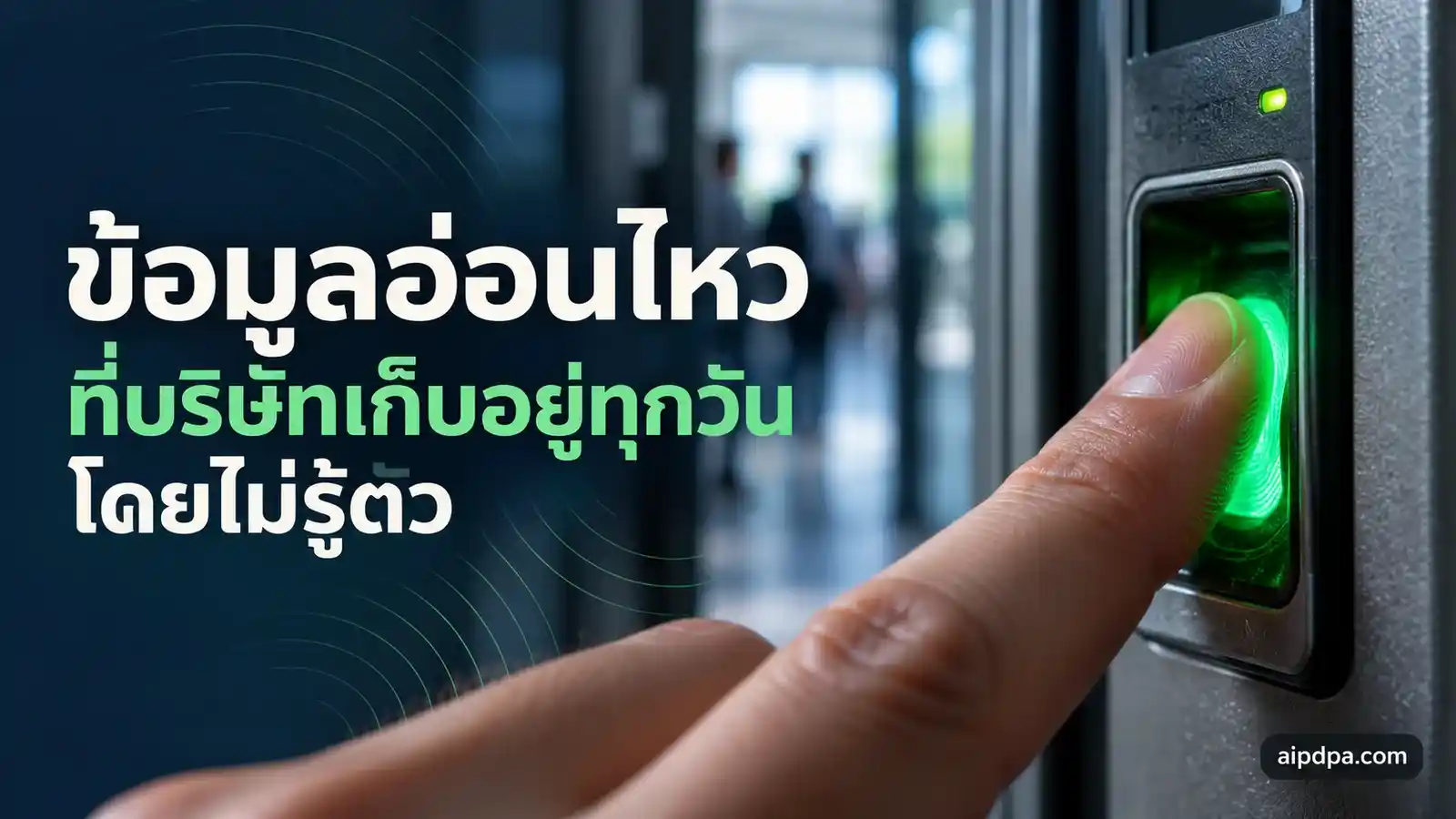
Sensitive data a company holds without knowing is section 26 data under Thailand's PDPA that rides along with routine work: doctor's notes, food-allergy fields, blood types and fingerprint time clocks. Unless an exception applies, it needs explicit consent. This guide helps HR, IT and DPOs find it, check the exceptions the PDPC Office and TDPG recognise, and fix the gaps.
- PDPA section 26 bars collecting health, biometric, religious, criminal-record and similar data without explicit consent unless an exception applies.
- A sick-leave medical certificate can rest on the labour-protection exception, as TDPG illustrates; no consent is needed.
- The PDPC Office told EXAT that biometric time clocks avoid consent only if four elements are met; if consent is used, an alternative must exist.
- Holding section 26 data removes the small-business exemption from the section 39 record (s.39, last paragraph).
- Breaching section 26 paragraph one carries an administrative fine of up to 5 million baht (s.84).
Ask an HR manager whether the company holds sensitive data and the first answer is usually "no, we're not a hospital". Then you open the files: doctor's notes in the sick-leave folder, a blood-type field on the staff record, a food-allergy box on the seminar sign-up, and a fingerprint scanner that has sat by the lifts for years.
Every one of these is data that section 26 of Thailand's Personal Data Protection Act B.E. 2562 (2019), the PDPA, forbids collecting without explicit consent or an exception. The problem is rarely bad intent. It is that nobody knows the data is there.
This article walks through where sensitive data usually hides, then shows where the statute, the consultation answers of the Office of the Personal Data Protection Committee (the PDPC Office) and the Thailand Data Protection Guidelines 4.0 (TDPG) take each case.
What counts as sensitive data under the PDPA?
The Act itself never says "sensitive data"; that is the industry's name for section 26 data. The list sits in the first paragraph.
Any collection of Personal Data pertaining to racial, ethnic origin, political opinions, cult, religious or philosophical beliefs, sexual behavior, criminal records, health data, disability, trade union information, genetic data, biometric data, or of any data which may affect the data subject in the same manner, as prescribed by the Committee, is prohibited, without the explicit consent from the data subject, except where:
Exceptions (1) to (5) follow: preventing danger to life, legal claims, and compliance with law for set purposes such as labour protection and social security in section 26 (5) (c).
The term that trips organisations most is "biometric data", because fingerprint and face scanners have become ordinary office kit. Section 26 defines it:
The biometric data in paragraph one shall mean the Personal Data arising from the use of technics or technology related to the physical or behavioral dominance of Person, which can be used to identify such Person apart from other Persons, such as the facial recognition data, iris recognition data or fingerprint recognition data.
Where does sensitive data hide in everyday operations?
The table gathers the usual hiding places. The right-hand column says which document discusses each one; "team example" means we drew it ourselves from the section 26 list rather than from a consultation or guideline.
| Everyday document or system | What rides along | Section 26 category | Who discusses it |
|---|---|---|---|
| Sick, maternity and sterilisation leave files | Medical certificates, symptoms, diagnoses | Health data | TDPG S4 and S6 |
| Staff records, party or seminar registration forms | Blood type, food allergies, vaccination history | Health data | TDPG D10 (examples of health data) |
| Fingerprint or face scanners for attendance, building access, cash drawers | Fingerprint templates, face templates | Biometric data | EXAT consultation; TDPG S40 |
| Pre-employment medicals and background checks | Medical results, criminal records | Health data; criminal record | TDPG (examples of highly private data) |
| Wheelchair service, accessible parking or rooms | Disability | Disability | TDPG S4 (airline example) |
| Photo on an ID-card copy | Dress that shows religious belief | Depends on the purpose of use | TDPG S2 |
| Payroll deductions for union dues | Union membership | Trade union data | Team example |
An ID photo reveals religion. Is that sensitive data?
TDPG's answer is useful and saves many companies from overreacting. Whether data is processed as sensitive data depends on what you use it for, not merely on what it happens to reveal.
You want to verify the identity of a service applicant using information on a national identity card. The identity card contains a photo of the service applicant wearing a headscarf indicating a religious belief. This photo is necessary to verify the identity of the service user. This does not constitute processing of such data as sensitive data, but such processing must still rely on a general lawful basis, without needing to meet the special conditions for processing sensitive data.
The same example carries a warning. If the company later groups customers whose ID photos show a headscarf, for any purpose, that use may become sensitive-data processing at once and will need a section 26 condition.
Does a sick-leave doctor's note need the employee's consent?
No, if it is collected so the employee can use statutory leave. TDPG gives exactly this example: the employer relies on the employment contract for the ordinary data on the certificate and on the labour-protection exception for the health data.
An employer processes an employee's data relating to sick leave, where the employee is entitled to wages even when not working due to sick leave. Under labor protection law, an employer may require an employee to submit a medical certificate for sick leave of 3 days or more. The information in the medical certificate contains both general personal data and sensitive data.
TDPG item S6 extends the same reasoning to sterilisation leave, maternity leave and social security claims. Watch the scope. A doctor's note in the leave file is there to decide the leave. If a manager later reads it during a performance review, that is a new purpose the original exception may not cover.
The food-allergy box on an event form is different, because no labour law requires it. The simplest route is to make it optional, say it is used only for catering, take explicit consent separately from anything else, and delete it after the event. That is our suggestion, not a statutory rule.
Fingerprint time clocks: what did the PDPC Office tell EXAT?
The Expressway Authority of Thailand (EXAT) collected staff faces and fingerprints for time recording; 3,314 people had enrolled, but one employee refused, worried the data might leak. EXAT asked the PDPC Office whether it could collect without consent and, if consent was needed and refused, what it could do.
The Office first confirmed this is biometric data under section 26 paragraph two. It then set out what must be shown before the labour-protection exception in section 26 (5) (c) applies.
(๑) ผู้ควบคุมข้อมูลส่วนบุคคลมีความจำเป็นต้องเก็บรวบรวมข้อมูลส่วนบุคคลดังกล่าวเพื่อการปฏิบัติตามกฎหมายฉบับใดฉบับหนึ่งหรือหลายฉบับ (๒) การเก็บรวบรวมข้อมูลส่วนบุคคลจะต้องเป็นไปเพื่อให้บรรลุวัตถุประสงค์เกี่ยวกับการคุ้มครองแรงงาน (๓) การเก็บรวบรวมข้อมูลส่วนบุคคลนั้นเป็นสิ่งจำเป็นในการปฏิบัติตามสิทธิหรือหน้าที่ของผู้ควบคุมข้อมูลส่วนบุคคลหรือเจ้าของข้อมูลส่วนบุคคลIn English: (1) the controller must need the data to comply with one or more laws; (2) the collection must serve labour-protection purposes; (3) it must be necessary to exercise the rights or perform the duties of the controller or the data subject. The decisive one is necessity. If there is evidence of buddy-punching such that, without biometrics, the employer cannot meet its labour-law duties, the exception may apply. If fraud is unproven, or a non-biometric method could solve the problem, it does not, and explicit consent is needed.
And if the employee refuses? Where biometrics are not necessary for time recording under the employment contract, EXAT must offer another way.
กทพ. จะต้องจัดให้มีวิธีการอื่นในการบันทึกเวลาทำงานและการดำเนินการที่เกี่ยวข้อง สำหรับพนักงานหรือลูกจ้างที่ไม่ให้ความยินยอมหรือถอนความยินยอมในการเก็บรวบรวม ใช้ หรือเปิดเผยข้อมูลชีวภาพดังกล่าวด้วยThe Office closed with two points private employers should note. Biometric processing carries inherently high risk, so security must match it. And if the legal basis changes in line with the answer, staff should be re-notified and the section 39 record corrected.
TDPG item S41 takes a similar line, more strictly for employment.
The use of biometric data must consider the necessity of using that data. If there is a less intrusive method available, that method should be considered first.
For employee data across the whole employment cycle, see Employee data from hire to exit.
Everyone signed a consent form. Why is that not enough?
Because explicit consent must be freely given, like any consent. If refusing means losing the service or the job, the consent may have no effect at all. TDPG offers several examples.
Members have no real choice, and face scanning is not necessary for the service (TDPG S5).
With a workable alternative, explicit consent can meet the conditions (TDPG S5).
Staff were compelled and had no freedom to refuse (TDPG S41).
The data is necessary for a service the passenger asked for (TDPG S5 (4)).
Note the last case. Consent can be tied to a service when the data is genuinely necessary for something the data subject requested. A scanner installed for the company's convenience always needs an alternative.
Once you hold sensitive data, what other duties follow?
Section 26 data does more than raise the consent bar. It closes exemptions that small businesses might otherwise use, starting with the section 39 record of processing.
The provisions in (1), (2), (3), (4), (5), (6) and (8) may not apply to the Data Controller who is a small organization pursuant to the rules as prescribed by the Committee, unless the collection, use, or disclosure of such Personal Data is likely to result in a risk to the rights and freedoms of data subjects, or not a business where the collection, use, or disclosure of the Personal Data is occasional, or involving in the collection, use, or disclosure of the Personal Data pursuant to section 26.
So a shop or small firm that assumes it is exempt from the record may lose that exemption with a single fingerprint time clock. Start the record with the plan in Data mapping in one week.
Second, the data protection officer. Section 41 (3) requires a DPO when the core activity is collecting, using or disclosing section 26 data. A company with doctor's notes in its leave files does not have that core activity, but a clinic, lab or health-screening firm may. See Which Thai companies must appoint a DPO.
Third, penalties. Section 84 sets a higher administrative fine for section 26 breaches than for ordinary ones.
Any Data Controller who violates section 26 paragraph one or three, or section 27 paragraph one or paragraph two, or section 28 in relation to the Personal Data under section 26, or fails to send or transfer the Personal Data under section 26 to be in accordance with section 29 paragraph one or paragraph three, shall be punished with an administrative fine not exceeding Baht five million.
How do you audit sensitive data in one afternoon?
No big project needed. Put the heads of HR, IT, facilities and sales in a room for two hours and work through this order.
- Open every form people fill in, paper and online. Circle any field asking about health, religion, disability, blood type, allergies or criminal record.
- Walk the building. Note every fingerprint reader, face scanner and camera that can recognise faces, and ask IT where templates are stored and who can access them.
- For each point, ask whether the data is used as sensitive data or merely rides along (the TDPG S2 test).
- Where it is used, look for a section 26 (1) to (5) exception first. If none fits, take explicit consent, separate from other consents.
- Wherever consent is the basis, check there is an alternative that is no worse for people who refuse.
- Delete fields you ask for but never use. Collecting less is risk removed.
- Log every point in the section 39 record, flag section 26 data, and check whether any small-business exemption still applies.
The AIPDPA RoPA register lets you flag section 26 activities as you record them and print a section 39 report when the PDPC Office or a data subject asks. See the demo account.
Frequently asked questions
What is sensitive data under the PDPA?
Section 26 lists racial and ethnic origin, political opinions, cult, religious or philosophical beliefs, sexual behaviour, criminal records, health data, disability, trade union information, genetic data, biometric data, and any other data the Committee prescribes.
Does a fingerprint time clock need employee consent?
Per the PDPC Office's answer to EXAT, if biometrics are shown to be necessary for labour-law duties, for example because of real buddy-punching, the section 26 (5) (c) exception may apply. Otherwise explicit consent is needed, plus another way to clock in for those who refuse.
Do I need consent for a sick-leave doctor's note?
TDPG's example says no: the employer uses the employment contract for ordinary data and the labour-protection exception for health data. Use it only to decide the leave.
Is an ID copy showing a headscarf sensitive data?
If used only to verify identity, TDPG says it is not processed as sensitive data and a general basis works. Grouping customers by that feature may turn it into sensitive-data processing that needs a section 26 condition.
Is a small business with a fingerprint scanner still exempt from the processing record?
The last paragraph of section 39 says the small-business exemption does not apply where section 26 data is collected, used or disclosed. Fingerprints are biometric data, so keep the record.
Law and sources
- Personal Data Protection Act B.E. 2562 (2019) — Section 26 · Section 39 · Section 41 (3) · Section 84
- PDPC Office: summaries of consultation answers under the PDPA
- Thailand Data Protection Guidelines 4.0 (guidance, not law) — S2–S6 · S40–S42 · D10
Text in the "The text" boxes is copied word for word from AIPDPA's legal knowledge base, transcribed from the Royal Gazette and official documents; every edit is checked by the system against that base, character by character. English wording is an unofficial translation; the Thai text prevails. This article is general information, not legal advice for a particular case.
Do it in the system

Who stands behind this guide?
Written by the AIPDPA legal team · Content owner: Phuwara Krobtaku, Attorney-at-law · Thai Barrister-at-Law · technology & intellectual property counsel
Lawyer's licence no. 477/2558 · Thai Barrister-at-Law · LL.M. in Intellectual Property & IT Law (Gold Medal)